http://www.bbc.co.uk/news/magazine-15216513
Monday, 10 October 2011
Article on re-discovering a French cemetery through smartphones
A great idea and one that could be done throughout any burial ground.....


Thursday, 1 September 2011
Cast Collection Conference
I will be presenting a paper entitled: The Monument, The Image and The Zeitgeist at the Cast Collection Conference at Edinburgh College of Art on the 10th September. This will discuss the development of the National Monument, from an exploration of the concept of the Parthenon and its association with the origins of the phrase "The Athens of the North," up to the present day.
Friday, 8 July 2011
5 Graveyards Project
I recently completed some research for the Edinburgh World Heritage Trust and the World Monuments Fund on the historical background of 5 of the Burial Grounds found within the Edinburgh World Heritage Site. This was for the 5 Graveyards project - see http://www.wmf.org/project/edinburgh-historic-graveyards.
This included background research on Greyfriars, Canongate and St Cuthbert's Kirkyards and Old and New Calton Burial grounds, using primary and secondary sources. The results of this work is to be published in the Autumn.
Thursday, 16 June 2011
The Lincoln Monument in Old Calton Burial Ground

Ever wondered about this monument and how it came about? A book available on Archive.org published in 1893 - at the time of this monument's unveiling - gives an interesting background to the history and meaning behind one of the few statues of Lincoln to be found outside of the United States.
Sunday, 6 March 2011
Saturday, 5 March 2011
Burns, Bombay and the British Empire

I will be presenting a paper on my research from India, and the connections to Calton Hill in a conference entitled the 'Object of Poetry' at the University of Dundee on the 26th March. This is the culmination of the AHRC and Beyond Text project entitled "Robert Burns: Inventing Tradition and Securing Memory, 1796-1909," which was carried out collectively between the University of Glasgow and the University of Dundee. The full programme for the can conference can be found here.
Saturday, 16 October 2010
ICOMOS Conference on Buildings Archaeology
Friday, 16 July 2010
Article on Calton Hill in Edinburgh Life

I have recently contributed to edition 5 of Edinburgh life magazine - A local magazine celebrating all that is Edinburgh - its history, culture and cityscape. Issues should be available in the shops in the Autumn, and after that will be available online at www.edinburghlifemagazine.com.
Tuesday, 1 June 2010
Death Commemoration and Memory: An Exploration of Representation, Concept and Change

A two-day conference is planned in Edinburgh for Thursday 24th and Friday 25th June 2010.
This is to provide a platform for interdisciplinary discussion on the themes of Death, Commemoration and Memory and to create new networks between researchers with similar interests throughout the academic community, from a variety of disciplines and academic institutions.
Further information can be found at:
www.dcm.ace.ed.ac.uk/contact.html
Wednesday, 5 May 2010
Thursday, 4 February 2010
Friday, 20 November 2009
Robert Adam's Bridewell on Calton Hill
A great website explaining the proposals and social background to Robert Adam's designs for the Bridewell on Calton Hill, which was demolished to make way for Thomas Tait's Scottish Office in the 1930s.
Tuesday, 1 September 2009
Interesting research paper on the National Monument
I had my attention recently drawn to an interesting research paper by a Dr Mark Fehlmann entitled " A building from which Derived"All that is good": Observations on the Intended Reconstuction of the Parthenon on Calton Hill. Its well worth a read if you are interested in the Hill and its monuments.....
Thursday, 6 August 2009
India and Calton Hill
In June, I was lucky enough to be awarded a research grant to India by the INTACH UK Trust. This came about after some extensive research on both the Burns and National Monuments on Calton Hill uncovered that the former had been instigated in Bombay (by such notables as Mountstuart Elphinstone and John Malcolm), while nearly 50% of the funding of the latter came from expatriates in the East India Company residing in Madras. I wrote a (very) small article on what I did out there for the Edinburgh World Heritage Trust newsletter - which included both archival research and research into Indian heritage and conservation work.
Saturday, 1 August 2009
Research trip to India

During the month of June, I spent four weeks in India carrying out work with three specific goals:
1: To locate and record information that helps to understand the impetus behind of ex-patriot Brits in India organising and contributing to monuments in Great Britain during the late eighteenth and early nineteenth century.
2. To undertake a wider exploration of the question of nationality and the perception of being a Scot in the British Empire, by looking at what it meant to be a Scot in India during the time of the British Raj.
3. To continue on from the work carried out by the INTACH Trust awarded grant last year that surveyed the Scots Cemetery in Kolkata in forging further links between conservation and heritage professionals in the UK and India.
The first two objectives were achieved by viewing a wide and varied range of archival material in the National Library in Kolkata, the Asiatic Societies in Kolkata and Mumbai, the Mountstuart Elphinstone College in Mumbai, the libraries of the University of Mumbai and the Madras Literary Society in Chennai.
The results of this trip provided both archival and physical data from the remains of structures and monuments that can still be found within the Indian landscape. This data assisted in the understanding of monument commemoration and its use in developing propaganda to foster emulation and admiration in those responsible for the expansion of the British colonies, encouraging a sense of duty in expatriates based overseas for the benefit of the British Empire.
However, as monuments were also erected within the British Isles, by considering the purpose for monuments identified in India in a comparative study with the purpose of commemorative monuments in Scotland, and considering these two places within the context of part of the British Empire with their own separate cultural definitions to London, I was able to formulate theories on the overall purpose and importance of these structures during the nineteenth century. By preparing a case study on a monument instigated in India, yet built in Scotland, the psyche of the people behind the building and fundraising for these structures could be further explored in a more general sense regarding the importance of commemoration, not only in Scotland or India, but worldwide. The results of these ideas will form the basis for future research on these themes and much of the research has been integrated into my PhD work, which now has a whole chapter devoted to memorials and commemoration as a result of my Indian trip.
Further work is also in the process of being proposed for the future which will consider the role that India played in funding and influencing urban development in the UK in both the 19th and 20th centuries, and this is planned as post-doctoral research which is specified further below and will be refined throughout the course of the next eighteen months.
The remains of the British Imperial monuments and structures studied during my visit to India were not only important in the interpretation of their historic use, but also their use in the present day, where many of these structures and statues are now redundant. To consider how the conservation of these structures can be carried out, not only in a physical sense, but also theoretically, was an extremely educational and humbling experience. Many structures contain negative associations for Indians in the 21st century and this raised questions over the challenges found worldwide in conservation regarding the appropriateness of use, interpretation and protection.
To fulfil the third objective of my trip, I met with a number of architectural professionals and heritage bodies as I travelled through the country. This included institutions such as the West Bengal Heritage Society, Sir JJ School Of Architecture, Mountstuart Elphinstone College, Archaeological Survey of India, the University of Mumbai, The Indian Museum in Kolkata, and local INTACH departments. I also met with a number of conservation architects in Mumbai, Hyderabad and Kolkata to view and discuss recently completed and current conservation projects in action.
Since my return to the UK, this research and experience has inspired and motivated me to become further involved in cross-cultural collaborations regarding the architectural history of buildings in India and also their conservation and re-development in their current environment.
This has included projects such as:
Working with the World Monuments Fund by carrying out research on the Osmania Women’s College in Hyderabad, which the WMF are currently restoring.
Archival work on the Scottish Church College (AKA Duff College) in Kolkata, which has assisted in the preparation of potential conservation proposals for the building.
Setting up talks in Edinburgh by eminent Indian conservation professionals during their visits to the UK. Numerous conservation professionals and academics in Scotland have attended these and have began to set up their own contacts between the UK and India, for the pursuit of further academic and professional discourse.
Inspired by this last outcome, I have also recently set up an academic forum on Scots in India (http://scotsinindia.wordpress.com/). This is the start of a potential post-doctoral project, for which proposals for funding are already being considered. However, at present this forum aims to integrate work from academics and professionals, not only based in the UK or even in India, but worldwide, in order to bring together the work being carried out on the legacies found from Scots in India through art, architecture and society both in India and Scotland.
Tuesday, 21 July 2009
Book on the Buildings of Burford
A review of a book for a town in Oxfordshire I was asked to read recently - would be great if this type of detailed historical and architectural information could be extended to be carried out in all parts of the UK.
Friday, 22 May 2009
SPP Consultative draft
The Scottish government are inviting comments on Scottish Planning Policy, which affects everything to do with the planning process in Scotland, including Cultural Heritage. The draft policy documents and where to send comments to can be found here.
Friday, 15 May 2009
Article for EWHT Journal
I was recently asked to write an article for the Edinburgh World Heritage Trust's first ever journal. It turned out to be a nice little publication and one that is great for reading over a coffee - if you can get your hands on a copy. Go to www.ewht.org for further details.
Sunday, 10 May 2009
Repairs to the Robert Burns Monument
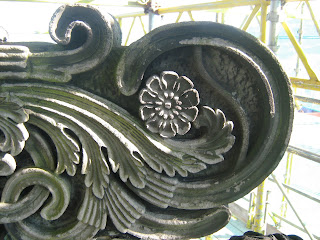
I was fortunate enough to be invited to the Burns Monument while repairs were being carried out to the structure. In having the opportunity to climb up the scaffolding and view the structure up close, it was fantastic to be able to see the detail of Thomas Hamilton's designs for this structure.



Detail of the cupola roof covered in imitation laurel leaves, which is taken from Stuart and Revett's Choragic Monument of Lysicrates - This can also be found on the Alloway Burns Monument.

Detail of the sejant, winged lions (not griffins, as they are described in Edinburgh's Buildings of Scotland guide) which support the finial. According to Joe Rock, in his publication on Thomas Hamilton's work, these are based on Charles H. Tatham's "Etchings of Ancient Ornamental Architecture", dating to 1806.
Detail of a lion water spout, situated at the wallhead guttering

Detail of the scrolled copings.
Many thanks to the City of Edinburgh Council and Ediburgh World Heritage Trust for allowing me to carry out this fascinating visit.
Tuesday, 21 April 2009
Cambridge Conference
I was asked to present a paper on Calton Hill at the 10th Annual Cambridge Heritage Seminar at Cambridge University. The weekend was interesting, with many different speakers coming from all over the world, but unfortunately highlighted the same problems in heritage conservation appear to be recurring again and again, whichever part of the world you hail from. You can find both my paper here and along with the other speakers papers on the website - just follow the links provided.
Subscribe to:
Posts (Atom)

 Posts


